
The Spiders Cincinnati Homeowners Are Most Likely to Encounter
Need Same Day Service? We Can Help.
Call Us Now at 283-444-9183.
The Spiders Cincinnati Homeowners Are Most Likely to Encounter
Cincinnati and the southwest Ohio tristate area — covering Hamilton, Warren, Butler, and Clermont counties in Ohio, plus the adjacent Northern Kentucky counties — is home to more than 600 spider species. In and around homes, most residents encounter a much smaller number regularly: the Common House Spider, the Cellar Spider, the Wolf Spider, the Orb Weaver, and, in parts of the tristate area, the Brown Recluse. Most of these are harmless. Two — the Brown Recluse and the Northern Black Widow — deserve attention if found inside the home.
Common House Spider
Small, tan-brown, builds tangled webs in corners, windows, and garages. Harmless. The most frequently encountered spider indoors.
Cellar Spider (Daddy Long-Legs)
Long thin legs, small body, builds loose webs in basements and crawl spaces. Harmless — venom is too weak to affect humans.
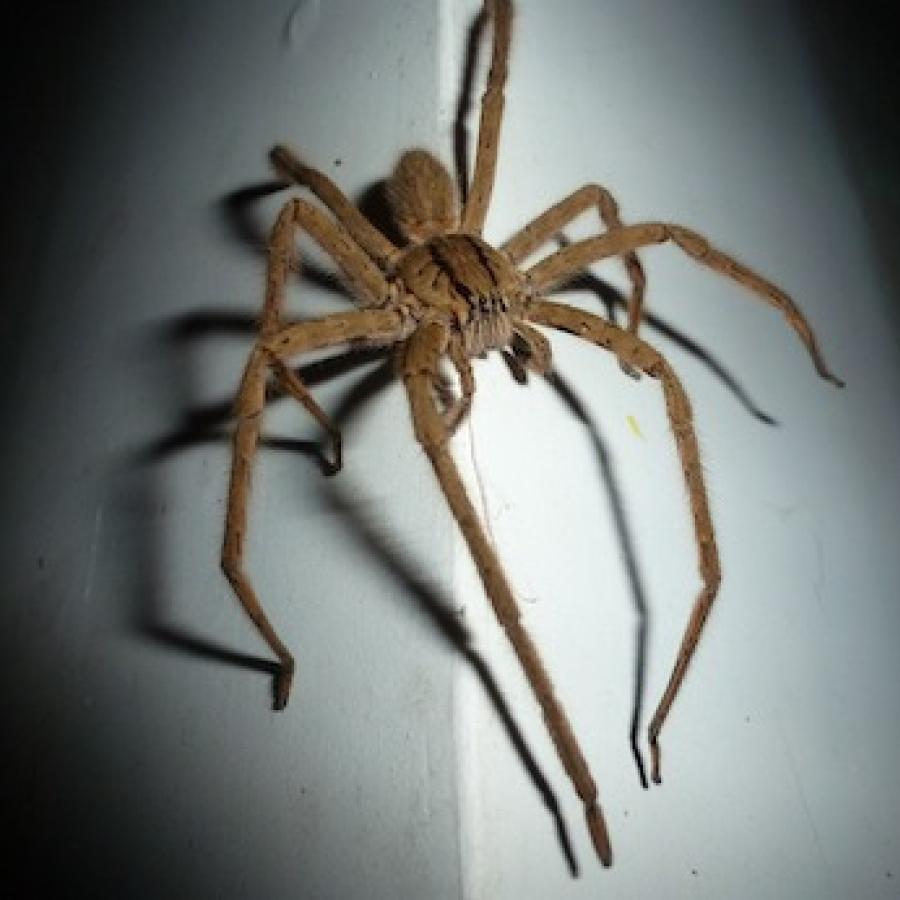
Wolf Spider
Large, fast-moving, does not build webs. Common in basements, garages, and along foundations. Bites rarely but bite is not medically significant.
Orb Weaver
Large, colorful, builds the classic wheel-shaped web in gardens and near exterior lights. Almost never enters homes. Completely harmless.
Brown Recluse
Tan to light brown, violin-shaped marking, six eyes in pairs. Present but uncommon in Cincinnati — more established in the Kentucky portion of the tristate. Bite is medically significant.
Northern Black Widow
Black, red hourglass on underside of abdomen. Rare indoors but found in undisturbed outdoor areas (woodpiles, old sheds). Bite requires prompt medical attention.
Wolf Spiders in Ohio: Large, Fast, and Mostly Harmless
Wolf Spiders are among the largest spiders Cincinnati homeowners encounter inside the home — females can reach an inch in body length, with a leg span that makes them look significantly larger. Wolf Spiders do not build webs; they hunt on the ground, which is why they are commonly seen moving quickly across basement floors, garages, and along foundation walls. Homeowners who encounter a Wolf Spider indoors often assume they have found a dangerous spider — in nearly all cases in Ohio, this is not accurate.
Wolf Spiders do bite if handled, but the bite produces localized pain and mild swelling comparable to a bee sting. They are not medically significant for healthy adults. If a large, fast-moving spider is appearing consistently inside the home, it is more useful to treat the situation as a general pest pressure indicator — they are hunting insects, so an abundance of Wolf Spiders indoors often signals an underlying insect activity problem worth investigating.
Brown Recluse Spiders in Cincinnati: What You Actually Need to Know
Brown Recluse spiders (Loxosceles reclusa) are established in the Ohio River Valley, and Cincinnati sits at the northern edge of their documented range in Ohio. They are more consistently present in Northern Kentucky — just across the river — than in Hamilton County proper, though specimens are found in Cincinnati. This is a genuinely more regional concern for tristate homeowners than for residents of Columbus or Cleveland, where Brown Recluse sightings are far less common.
Identification myth worth knowing: Nearly every large, brownish spider in Ohio gets called a "Brown Recluse" by homeowners. True Brown Recluse spiders are smaller than most people expect (body about 1/4 to 1/2 inch), tan to light brown, with a violin-shaped marking on the top of the cephalothorax, and — crucially — six eyes arranged in three pairs rather than the eight eyes most spiders have. Wolf Spiders, Common House Spiders, and Grass Spiders are all far more common in Cincinnati and are routinely misidentified. If you believe you have found a Brown Recluse, a photo sent to a licensed pest professional for ID is the right next step before taking any action.
Brown Recluse spiders do not actively seek out people. They hide in dark, undisturbed spaces — attic insulation, old cardboard boxes, clothing left undisturbed, cluttered storage areas, inside shoes. Bites occur almost exclusively when the spider is trapped against the skin. Necrotic skin reactions from Brown Recluse bites are real but occur in a minority of cases; most bites cause localized pain and inflammation that resolves without medical treatment. Any suspected Brown Recluse bite that develops an expanding skin lesion should be evaluated by a physician.
When Spiders Inside Your Home Signal a Larger Problem
A few spiders inside a home in any given year is normal in the Cincinnati area — spiders enter through gaps, vents, and openings around doors and windows. An increasing number of spiders inside, or spiders consistently appearing in living areas rather than basements and garages, is worth taking seriously as a signal. Spiders do not move into spaces with no food source. A consistent indoor spider population means insects are present at levels sufficient to support a hunting or web-building population.
If general pest control treatments are already reducing overall insect activity inside the home, spider pressure typically follows. Addressing spider populations in isolation — without treating the underlying insect activity — tends to produce only temporary results.
High-activity areas worth checking in Cincinnati homes include basement rim joists, crawl space access points, utility penetrations through the foundation, and gaps around doors and windows. Older homes in areas like Anderson Township, Milford, and Harrison often have more entry points due to settling and aging construction, which increases general pest and spider pressure.
Frequently Asked Questions: Spiders in Cincinnati and Southwest Ohio
Are there dangerous spiders in Cincinnati, Ohio?
Two medically significant spider species are present in the Cincinnati tristate area: the Brown Recluse and the Northern Black Widow. Both are uncommon indoors. The Brown Recluse is at the northern edge of its range in Ohio and is more established in Northern Kentucky. The Northern Black Widow is found outdoors in undisturbed areas. The vast majority of spiders encountered in Cincinnati homes — Common House Spiders, Cellar Spiders, Wolf Spiders — are harmless.
Why are there so many spiders in my Cincinnati basement?
Basements in southwest Ohio homes concentrate spiders for two reasons: moisture and insect activity. Cellar spiders, Common House Spiders, and Wolf Spiders all favor cool, humid, undisturbed spaces that tend to have higher insect populations. If spider numbers are increasing in a basement, it typically reflects increased moisture (check for condensation on pipes, basement wall seepage) or increased insect activity entering through foundation gaps or crawl space vents.
When are spiders most active inside homes in Ohio?
Spider activity peaks inside Ohio homes in late summer and fall — typically late August through October. Male spiders in particular move more frequently in late summer as they search for mates, which is when homeowners notice the most sudden increases in spider sightings. This is entirely normal seasonal behavior and not a sign of an infestation. Spider populations naturally decline through winter as interior insect activity drops.
Does killing a spider inside release its eggs?
This is a widespread myth. Female spiders do carry egg sacs, but the eggs inside are not released or activated when the spider is killed. Spider eggs require specific conditions — temperature, humidity, timing — to hatch. Killing a spider with an egg sac does not cause an explosion of spiderlings in your home.
Seeing More Spiders Than Usual in Your Cincinnati Home?
Consistent spider activity inside often means something else is going on. D-Bug Pest Control can inspect, identify the source, and put together a treatment plan that addresses the full picture — not just the spiders. Call 283-444-9183 or get a free estimate below.
Get a Free Estimate