
The Three Ants Most Likely in Your Cincinnati Home This Summer
Need Same Day Service? We Can Help.
Call Us Now at 283-444-9183.
The Three Ants Most Likely in Your Cincinnati Home This Summer
Three ant species account for the majority of summer ant activity inside Cincinnati homes: the Carpenter Ant, the Pavement Ant, and the Odorous House Ant. They look different, nest in different locations, and respond to different treatment approaches. Treating the wrong ant the wrong way is the most common reason DIY ant control fails — and knowing which species you have is the first step to solving the problem.
Carpenter Ant
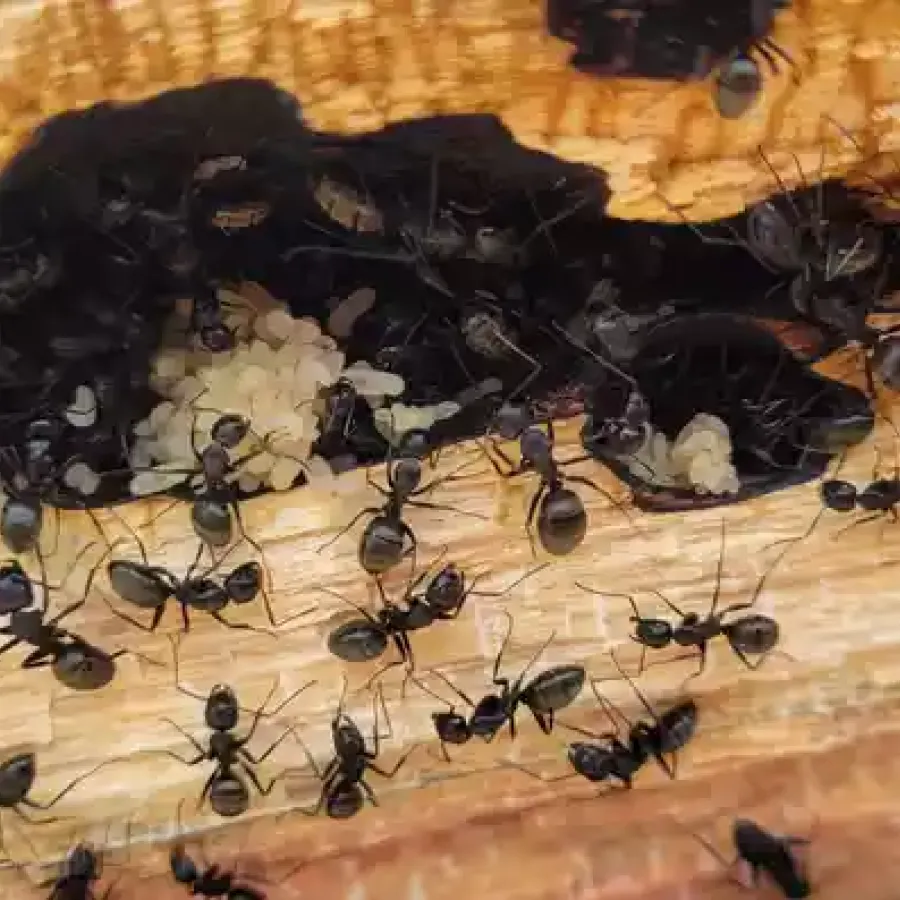
Large (1/4 to 1/2 inch), black or red-and-black. Nests in moist, damaged wood. Active outdoors May–August, workers forage indoors at night. Can cause structural damage over time.
Pavement Ant
Small (1/16 to 1/8 inch), dark brown to black. Nests under slabs, driveways, and foundations. Trails visible along baseboards and kitchen floors in summer.
Odorous House Ant
Small (1/16 inch), dark brown. Smells like rotten coconut when crushed. Follows moisture trails into kitchens. Nests in wall voids and under floors near warmth and water sources.
Carpenter Ants in Ohio: The Ant That Actually Damages Your Home
Carpenter Ants are the largest ants most Ohio homeowners encounter — workers range from 1/4 to 1/2 inch, and winged reproductives (swarmers) can be larger. Carpenter Ants do not eat wood like termites; they excavate it to build nesting galleries. The tunneling itself causes structural damage over time, particularly in wood that has been compromised by moisture. In Cincinnati, Carpenter Ants are most commonly found nesting in: window frames and sills with moisture damage, wood in contact with soil around decks and porches, soffits and roof fascia with water infiltration, and crawl space joists in older homes with humidity or condensation issues.
Carpenter Ant activity peaks in May through August in southwest Ohio. Workers forage at night, which is why homeowners often notice them moving across kitchen counters or floors after dark. Daytime sightings inside the home — especially of large workers — are a more significant indicator because it suggests foraging pressure from a colony that is either very large or nesting close to the structure.
Common myth corrected: Seeing Carpenter Ants outdoors does not mean they are nesting inside your home. Carpenter Ants forage up to 300 feet from the colony. A line of Carpenter Ants outside along a fence or entering a tree stump means there is a colony in the yard — not necessarily in the house. Consistent indoor sightings at night, sawdust-like frass near a wall void, or faint rustling sounds inside wall cavities are the indicators that point toward an indoor nest.
Pavement Ants and Odorous House Ants: A Nuisance, Not a Structural Threat
Pavement Ants and Odorous House Ants are the small ants that trail across kitchen floors, follow grout lines, and appear in long columns near baseboards. Both species are extremely common in Cincinnati and southwest Ohio during summer months. Neither species damages wood structures. Their colonies are established in soil under concrete, inside wall voids, or beneath flooring — they enter homes following moisture gradients and food traces.
Odorous House Ants are particularly persistent because their colonies can have multiple queens spread across multiple satellite nests, which makes perimeter sprays alone ineffective. Treating with a repellent spray causes the colony to split and relocate, often deeper into the wall void or to a more protected location. Bait-based treatment — where workers carry slow-acting bait back to the colony — is the more effective approach for these species.
Why Cincinnati's Older Homes Have a Higher Ant Problem Rate
Southwest Ohio has a significant proportion of housing stock built before 1970, particularly in Hamilton County neighborhoods like Anderson Township, Loveland, and Harrison. Older homes create more conducive conditions for Carpenter Ant nesting because: wood-to-soil contact is more common in older construction standards, moisture infiltration in aging foundations creates the damp wood Carpenter Ants prefer, crawl spaces without proper vapor barriers accumulate enough humidity to support colony establishment, and decades of settling create more gaps and entry points around utility penetrations, doors, and windows.
This does not mean all older homes have Carpenter Ants — it means the inspection and prevention priorities for an older Cincinnati home are different than for newer construction. Maintaining dry wood, sealing foundation gaps, and keeping wood mulch away from the foundation are the highest-leverage preventive steps for these properties.
What Works for Summer Ant Control (And What Doesn't)
The most common DIY mistake with summer ants is reaching for a can of spray and treating what's visible. This provides short-term reduction but rarely solves the problem because the colony — which may contain tens of thousands of workers — is untouched. Workers that are killed are quickly replaced. For Odorous House Ants in particular, repellent spray can scatter the colony and make the problem significantly harder to control.
Effective professional ant control in Cincinnati involves identifying the species correctly, locating nesting areas (inside the structure, under slabs, or in the yard), and applying the appropriate treatment for that species — bait-based programs for Odorous House Ants and Pavement Ants, targeted void treatment and moisture assessment for Carpenter Ants. A treatment that does not address the nesting site will not provide lasting results regardless of what product is used.
- Keep foundation areas dry — fix leaking gutters, extend downspouts, and grade soil away from the structure
- Eliminate wood-to-soil contact at deck posts, lattice, and trim boards
- Store firewood away from the home's exterior and off the ground
- Seal gaps around utility penetrations, doors, and windows at the foundation level
- Address any moisture-damaged wood — Carpenter Ants select nesting sites based on wood moisture content, not wood species
Frequently Asked Questions: Ants in Cincinnati Homes
Why do ants suddenly appear in my Cincinnati home in summer?
Ant colonies in Ohio ramp up foraging activity significantly in late spring and summer as temperatures rise and the colony's food demand increases. Worker populations peak from May through August, which is when homeowners see the most activity indoors. Summer also dries out some outdoor food sources, pushing foragers to enter structures where food, water, and temperature regulation are more reliable. The ants were present before summer — the colony was just smaller and foraging less.
Are Carpenter Ants dangerous to Ohio homes?
Carpenter Ants can cause meaningful structural damage over time, particularly in homes with moisture-compromised wood. They do not eat wood — they excavate it — so the damage rate is slower than with termites. A small colony discovered and treated early typically has not caused significant damage. A large, well-established colony that has been nesting in a wall void or crawl space joist for several years can hollow out a substantial section of wood. The earlier it is identified, the lower the remediation cost.
Why do my ant treatments from the store stop working after a few days?
Most consumer ant sprays are repellent formulas — they kill ants on contact but also cause surviving ants to avoid the treated area. This creates a temporary reduction in visible activity without reaching the colony. Repellent products are also counterproductive for Odorous House Ants, which have multi-queen colonies that split in response to threats. Bait formulas, which are carried back to the colony by foragers, are more effective for nuisance ant species and are the basis of professional treatment programs.
How long does professional ant treatment take to work?
Bait-based treatments for nuisance ant species like Odorous House Ants and Pavement Ants typically show significant reduction within 1 to 2 weeks as bait is distributed through the colony. Full colony elimination can take 3 to 6 weeks depending on colony size. Carpenter Ant treatment results depend on whether the nesting site was reached — a treated colony in a wall void may decline within days, while a large outdoor colony with active foragers may require follow-up visits.
Ants Taking Over Your Cincinnati Home This Summer?
Getting rid of ants starts with knowing which kind you have and where they are coming from. D-Bug Pest Control identifies the species, locates the source, and uses the right approach to actually eliminate the colony. Call 283-444-9183 or get a free estimate below.
Get a Free Estimate