
Carpenter Ants vs. Termites in Older Pennsylvania Homes: 5 Ways to Tell Them Apart
Need Same Day Service? We Can Help.
Call Us Now at 724-209-4758.
Carpenter ants and termites can be told apart by five checks: waist shape, antenna shape, wing size, what they leave behind, and how the tunnels look inside the wood. Both turn up in older Pennsylvania homes, and both are drawn to moisture, so a damp sill or a leaking porch roof can host either one. Termites eat wood, while carpenter ants only hollow it out, which changes how serious the problem is and how it gets fixed.
How do carpenter ants and termites compare side by side?
Carpenter ants and termites differ in body shape, wings, and the debris they leave. This table puts the five checks in one place.
| Check | Carpenter ant | Termite |
|---|---|---|
| Waist | Pinched, with a clear narrow waist | Broad, with no visible waist |
| Antennae | Elbowed | Straight and bead-like |
| Swarmer wings | Front wings longer than hind wings | All four wings about equal in length |
| What it leaves behind | Piles of coarse sawdust-like debris under small holes | Mud tubes on foundations, posts, and joists |
| Inside the wood | Smooth, clean tunnels | Tunnels packed with mud |
1. Look at the waist and antennae first
A pinched waist and elbowed antennae mean ant, and a broad body with straight antennae means termite. An Extension specialist answering a homeowner's question described the three main differences between ants and termites: antennae that are elbowed on ants and bead-like on termites, a noticeably pinched waist on ants and none on termites, and wings of uneven length on ants. A phone photo through a magnifier or a clear bag makes these features easy to see.
2. Compare the wings on any swarmers
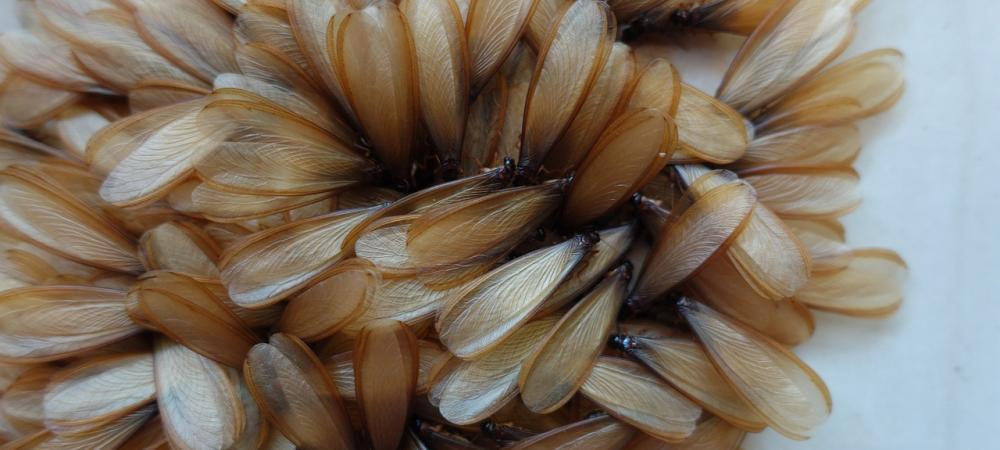
Winged insects indoors need a close look at the wings. Termite swarmers have four wings of equal length, while ant swarmers have front wings clearly longer than the hind pair. Winged carpenter ants resemble winged termites at a glance, which is why wing length is the check to trust. Discarded wings on a windowsill can answer the question even when the insects are gone.
3. Check what they leave behind
Carpenter ants leave debris, and termites leave mud. Penn State Extension notes that termite tubes show up on cellar walls, wooden posts, studs, mudsills, and door and window trim, and that wood in suspect areas should be probed for soundness. Carpenter ants push coarse debris out of small holes, so a small pile of sawdust-like material under a hole points to ants.
4. Look inside any damaged wood
Smooth, clean tunnels point to carpenter ants, and mud-packed tunnels point to termites. The University of Nebraska-Lincoln Extension states that carpenter ant galleries are smooth, very different from termite damage packed with mud. The difference matters because carpenter ants do not eat wood. Penn State extension entomologist Steven Jacobs has noted that carpenter ants are usually little more than a nuisance, and the Nebraska guide advises finding and repairing the moisture problem that drew them.
5. Match the damage to moisture
Both insects follow moisture, so a wet spot is the place to look. Penn State's Jacobs notes that carpenter ants usually do not infest sound wood below about 15 percent moisture. The Nebraska guide adds that areas around and under windows, roof eaves, decks, and porches are the most vulnerable to moisture. Subterranean termites also need moisture, which they get from the soil through their mud tubes.
What prevents both in an older home?
Fixing moisture and keeping wood off the ground prevents both insects. Replace water-damaged wood, repair leaking gutters, roofs, and pipes, and store firewood away from the house and off the ground. Jacobs also advises sealing the holes where pipes and wires enter the house. These steps cost little compared with repairing damaged framing.
What should you do if you find one of them?
Finding either insect means calling for an inspection, because the two need different treatments. D-Bug Pest Control offers a free on-site termite inspection, and the technician inspects all accessible and visible areas of the property. Sentricon bait stations, where termites are found, are checked once a year and rebaited as needed. Ants are covered by general pest control, and the termite control page explains the termite process. Our guide to early signs of termite activity adds more to watch for.
Frequently asked questions
Do carpenter ants eat wood?
Carpenter ants do not eat wood. They hollow it out to build nests and push the debris outside, which is why sawdust-like piles appear under small holes. Termites are the insects that eat wood.
How can I tell a termite swarmer from a flying ant?
A termite swarmer has a broad waist, straight antennae, and four wings of equal length. A flying ant has a pinched waist, elbowed antennae, and front wings longer than the hind wings.
When do termites swarm in Pennsylvania?
Eastern subterranean termites swarm in Pennsylvania in late winter or early spring, according to Penn State Extension. Swarmers that appear inside a building are often seen around doors and windows because they are drawn to light.
Are carpenter ants as damaging as termites?
Carpenter ants are usually less damaging than termites. Penn State's Jacobs calls them little more than a nuisance in many cases, though nests in water-damaged wood point to a moisture problem that should be fixed.
Found winged insects or sawdust piles and not sure which you have? Call D-Bug Pest Control at 724-209-4758 and we'll help you figure out the right next step.
Call 724-209-4758