
Ground, Deck, and Eave Nests: Where Yellow Jackets and Hornets Build Around West Virginia Homes
Need Same Day Service? We Can Help.
Call Us Now at 304-362-9343.
Yellow jackets and hornets build nests in five common places around a West Virginia home: abandoned animal burrows in the ground, wall voids, eaves and soffits, trees and shrubs, and old stumps or woodpiles. Cornell University's Integrated Pest Management program notes that some yellowjackets prefer voids such as hollow trees, structural walls, abandoned animal burrows, and rotting stumps, while others build aerial nests in trees or under the eaves of out-of-the-way buildings. Knowing the spots makes a nest easier to find before someone walks, mows, or reaches into it.
Where do yellow jackets and hornets nest around a house?
Nests sit in the five places in this table, and the nest type tells you how careful to be. The table pairs each spot with what to watch for.
| Nest spot | What to look for | Who builds there |
|---|---|---|
| Ground burrows | A steady stream of wasps entering and leaving a small hole in the lawn or bank | Yellowjackets that use abandoned animal burrows |
| Wall voids | Wasps entering a gap in siding, trim, or a foundation crack | Yellowjackets that nest in structural walls |
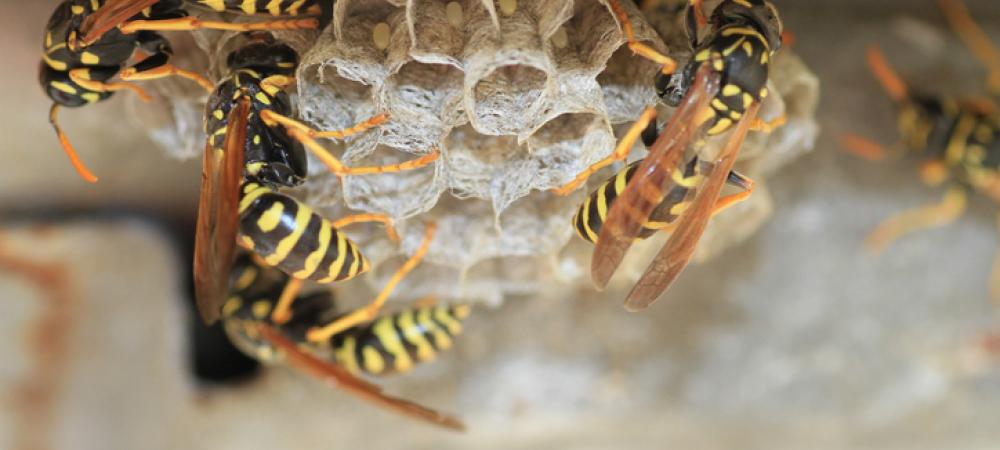
| Eaves and soffits | A papery nest under the roofline or on a shed | Aerial yellowjackets and hornets that nest near buildings |
| Trees and shrubs | A rounded paper nest hanging from a branch | Aerial yellowjackets and hornets |
| Stumps and woodpiles | Wasps entering the hollows of rotting wood | Yellowjackets that nest in tree and stump hollows |
1. Ground burrows and lawn edges
Ground nests are the hardest to see and the easiest to disturb. Cornell's IPM program lists abandoned animal burrows as a preferred yellowjacket nest site, so a nest can sit in a lawn, a field edge, or a bank with only a small hole showing. Watch where wasps come and go to find the entrance, and keep mowers and walkers away from it. A nest in the ground often goes unnoticed until a foot or a mower disturbs it.
2. Wall voids and siding gaps
Wasps going in and out of a gap in siding or trim usually have a nest in the wall. Cornell recommends sealing the holes and entryways that wasps use to reach wall voids. Sealing comes after the nest is dealt with, since wasps that cannot get out the way they came in may find another route. This is a job for a professional who can treat the nest first and then close the opening.
3. Eaves, soffits, and sheds
Aerial nests under eaves and on outbuildings are easy to spot and easy to underestimate. Cornell notes that some yellowjackets build aerial nests under the eaves of out-of-the-way buildings, and bald-faced hornets can become a problem when a nest is built near human activity and gets disturbed. A nest over a door or a deck is a hazard because people pass under it daily.
4. Trees and shrubs
Rounded paper nests in trees and shrubs often start small and grow through summer. Cornell's IPM program describes aerial nests built in trees, wrapped in layers of paper envelope that make the nest rounded. Trim around the yard in early spring and look at the ends of branches near play areas, patios, and driveways.
5. Stumps and woodpiles
Rotting stumps and woodpiles are common wasp nest sites on rural properties. Cornell lists rotting tree stumps as one of the voids yellowjackets favor. Stack firewood off the ground and away from the house, and check older stumps near a garden or trail before clearing them.
When should you call a professional?
Call a professional for any large nest, any nest in a wall, and any nest near a door, deck, or play area. Cornell's guidance says that if a large nest cannot be ignored, a pest control expert or the local cooperative extension office is the right call. D-Bug Pest Control's stinging insect control covers wasps, yellow jackets, hornets, and carpenter bees, and the technicians are state-licensed and treat the stinging insects causing problems while keeping beneficial pollinators in mind. The stinging insect control page has the details, and homeowners in Eglon can see local information on the stinging insect control page for Eglon.
Frequently asked questions
Where do yellow jackets build their nests?
Yellow jackets build in voids such as abandoned animal burrows, hollow trees, rotting stumps, and structural walls, and some build aerial nests in trees or under eaves. Cornell University's IPM program describes both types.
How do I find a wasp nest?
Watch where the wasps fly in and out, since the flight path leads to the entrance. Cornell's IPM program recommends this approach, and it works best from a safe distance and in good light.
Should I remove a large nest myself?
A large nest is best left to a professional. Cornell's IPM program advises calling a pest control expert or the local cooperative extension office when a large nest cannot be ignored.
Are all bees and wasps a problem?
Not every bee or wasp needs treatment. D-Bug Pest Control treats the stinging insects that are causing problems and keeps beneficial pollinators in mind.
Found a nest near the house or the kids' play area? Call D-Bug Pest Control at 304-362-9343 and we'll help you figure out the right next step.
Call 304-362-9343